
News
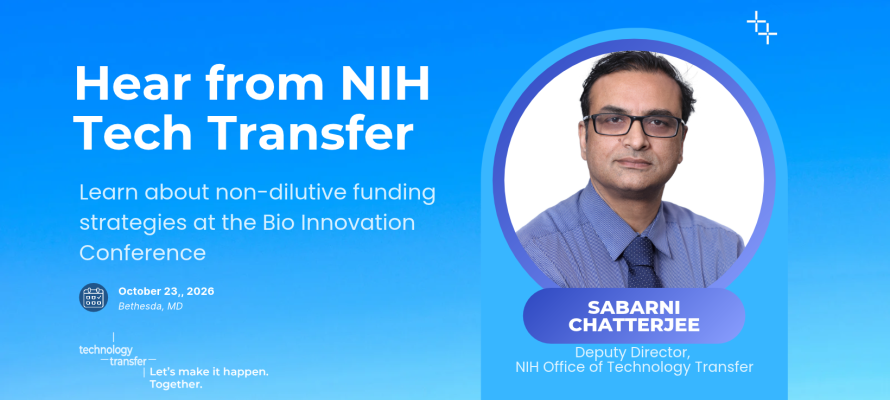
NIH OTT Deputy Director Sabarni Chatterjee will lead an interactive round table at the Maryland Tech Council’s Bio Innovation Conference focused on how you can receive non-dilutive support from the federal government without writing grants. Topics include: Partnerships providing indirect/in-kind
Currently, there is no effective treatment for many types of retinal degeneration. Nor are there sufficient treatments for autoimmune uveitis, as current uveitis treatment primarily uses steroidal anti-inflammatory medication, which can produce significant unwanted side effects with long-term use
NIH inventors have developed an image-based machine learning system that is able to validate functional cell phenotypes. The system may be trained to automatically recognize image features that correlate with a desired cell-type or properties for research, diagnostic, and therapeutic purposes. This
NIH inventors have developed a mutation-independent method to treat Leber congenital amaurosis (LCA), retinitis pigmentosa (RP), other inherited retinal degenerations (IRDs), and age-related macular degeneration (AMD) using the FDA-approved small molecule, Halofantrine. NIH inventors found