
Home
Explore NIH Technologies
Explore work by over 1,500 NIH researchers | Available for Licensing & Collaboration
News
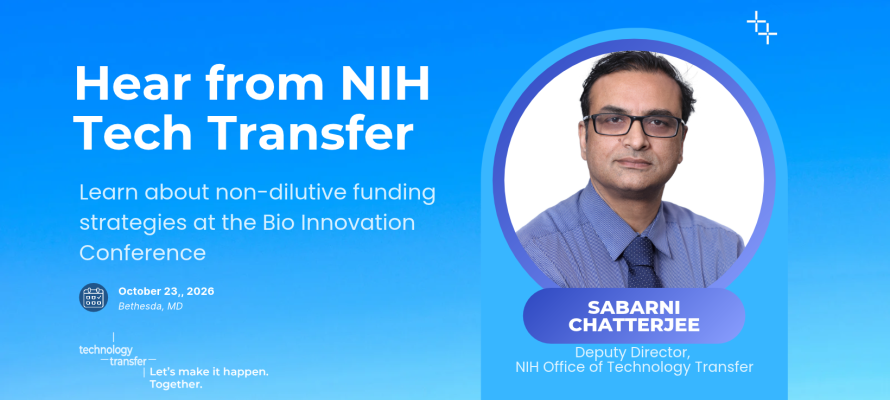
NIH OTT Deputy Director Sabarni Chatterjee will lead an interactive round table at the Maryland Tech Council’s Bio Innovation Conference focused on how you can receive non-dilutive support from the federal government without writing grants. Topics include: Partnerships providing indirect/in-kind
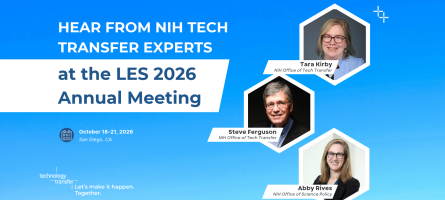
The Licensing Executives Society (LES) USA-Canada annual meeting is taking place in San Diego from October 18-21, 2026. Three members of the NIH Technology Transfer Community will be speaking. NIH Office of Technology Transfer Director Tara Kirby will be speaking on the panel Evolving Best Practices
Blood clots are a silent threat behind many serious illnesses—from sepsis and cancer to viral infections and autoimmune disease. Now, inventors at the NIH National Cancer Institute (NCI) have identified a promising new way to stop dangerous clots before they spiral out of control, without increasing
Imagine treating a genetic disease not by managing symptoms for life, but by correcting the underlying genetic error itself. Inventors at NIH are advancing that vision with a gene editing technology designed to deliver highly precise genetic corrections, opening new possibilities for therapies that
Explore Featured Research
Get updates on the latest and most exciting research coming out of NIH...
Explore Featured Products
Novel and interesting products coming to market through NIH inventions and partnerships...
Available Technologies
Unable to load technology listings at this time. Please try again later.