
News
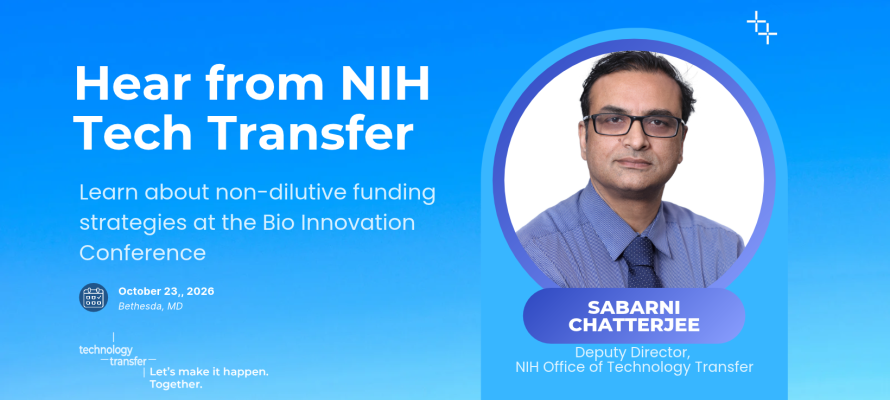
NIH OTT Deputy Director Sabarni Chatterjee will lead an interactive round table at the Maryland Tech Council’s Bio Innovation Conference focused on how you can receive non-dilutive support from the federal government without writing grants. Topics include: Partnerships providing indirect/in-kind

Did you know that companies from other countries can collaborate with or license from the National Institutes of Health (NIH)? It can be daunting to find a technology that your company is interested in and know where to begin the collaborative process. If your company is interested in technology

Are you interested in expanding your technology transfer knowledge? The Foundation for Advanced Education in the Sciences (FAES) Fall 2021 courses at the NIH are now open for registration! The Advanced Studies in Technology Transfer is an inexpensive open enrollment program. This semester’s courses
Have you ever wanted to get recognition for outstanding success in technology transfer? Perhaps you just want to share your innovative technology transfer approaches with the broader federal technology transfer community? Well, your timing is perfect! The Federal Laboratory Consortium (FLC) will be