
Licensing/Collaboration Opportunity for Inflammatory Diseases Therapeutic
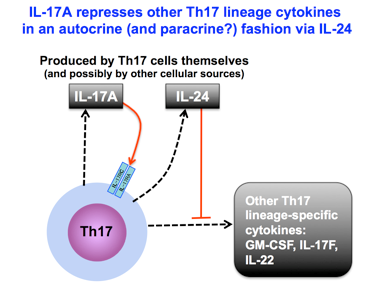
NIH inventors have developed a new strategy of using Interleukin 24 (IL-24) to target the whole T-helper 17 cells (Th17) lineage and thus achieve improved efficacy in therapy of Th17-relevant autoimmune diseases such as uveitis, multiple sclerosis, rheumatoid arthritis, and Crohn’s disease. The Th17 response, which may cause autoimmune and autoinflammatory diseases, is an uncontrolled activation of Th17 cells. IL-17A represses other Th17 lineage cytokines by upregulating the regulatory cytokine IL-24. Loss of this regulatory pathway due to IL-17A neutralization, and consequent upregulation of the other Th17 cytokines, may result in reduced efficacy of anti-IL-17A therapy. The inventors suggest that targeting the Th17 lineage cytokines as a class, by augmenting IL-24, may be a better approach for controlling the Th17 response than targeting IL-17A alone.
This strategy is designed to bring other members of the Th17 pathway back to normal levels, rather than massively inhibiting them by targeting its most proinflammatory member, IL-17A. This strategy may avoid patients’ exposure to infections that are possible when targeting IL-23 and IL-12 via combination therapy, or the STAT3 blockade.
If you are interested in learning more about this potential therapeutic or contacting the licensing manager, please view the abstract: Interleukin 24 (IL-24) to Treat Inflammatory Diseases